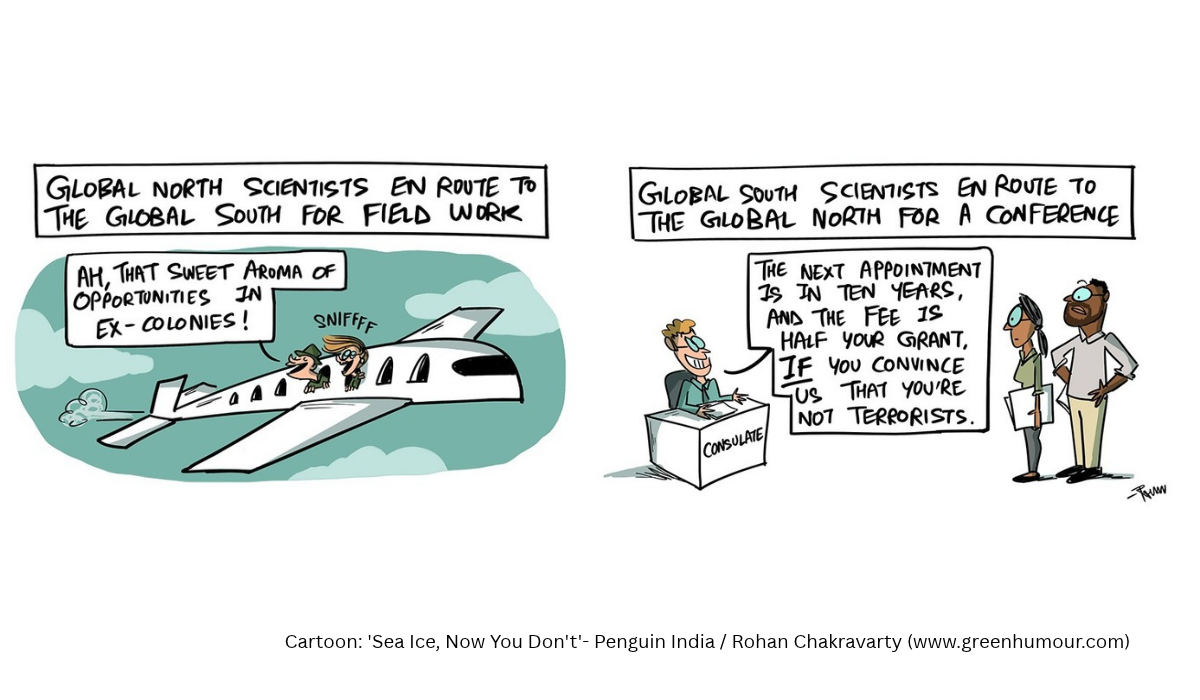


Transforming the International Development Cooperation System – Mission Impossible?

Interview with Aram Ziai, Chair of Development and Postcolonial Studies, University of Kassel, Germany.

Professor Aram Ziai is an academic who has been writing on Post-Development for over 20 years. His work is all centred around decolonising the sector – and on how colonial injustices are still effective in our day-to-day life. He is also Executive Director of the Global Partnership Network, which has been explicitly set up to try to decolonise international cooperation and knowledge production as far as the structures of the ‘development industry’ will allow.

Continue reading “Transforming the International Development Cooperation System – Mission Impossible?”

Merit, Meritocracy, and Decolonising Knowledge for Development

By Amitabha Sarkar / part of our “Share your Decolonising Story” project

I grew up in a family shaped by the complexities of colonial misadventure in Calcutta, a refugee past marked by economic hardship and structural violence. For my mother, merit was the only way out. She believed that humility, hard work, and academic excellence could open doors that history had closed. As a child and young adult in South Asia, I absorbed this moral ideal without question.

Continue reading “Merit, Meritocracy, and Decolonising Knowledge for Development”

Feeling the Colonial: Affective Decolonisation in Development Studies Classrooms

By Carla Maria Friederike Diem / part of our “Share your Decolonising Story” project

“I hope for a world where International Development Studies cease to exist.” was the first line of my motivation letter to the University of Amsterdam (UvA). A provocation, yes – but also a belief. A way to signal that I saw the contradictions at the heart of the discipline – that a field born out of colonial legacies, and sustained by the hierarchies it claims to dismantle, cannot be reformed without eventually ceasing to exist. I thought this was an idealistic position. What I did not realise was just how intimately I would come to feel the weight of those contradictions – in my emotions, in my learning, and in my hope.

Continue reading “Feeling the Colonial: Affective Decolonisation in Development Studies Classrooms”

Thinking Beyond the Colonial Ecosystem

By Touseef Mir / part of our “Share your Decolonising Story” project

The concept of development has been significant in shaping the current texture of the world and society around us. Not only was development an important tool of the European colonial enterprise, but the notion of development also resonates with similar power hierarchies. However, there is increasing realisation, especially within academia, about not only the colonial beginnings of development but its continued and significant (neo)colonial hues, be it in theory, policy or praxis of development.

Continue reading “Thinking Beyond the Colonial Ecosystem”

The Role of Critical Poetic Inquiry in Decolonising ‘Development’

By Nita Mishra

For Development Studies (DS) to truly decolonise itself, it must include the voices that do not find their way to its dominant narrative. To locate these hidden voices, and amplify them, DS scholars must embrace newer ways of doing research. Newer ways of doing research means adopting newer tools or methods of doing research with the aim to identify sources of forgotten or hitherto ignored knowledge. Whose voice is heard and whose knowledge counts, in essence, is therefore a call to facilitate a more inclusive process of knowledge creation. For instance, while discussions on intellectual decolonization underly all four schools of DS, it still begets the question ‘what research methods are best suited to advance the ‘de-colonial’ imagination of ‘Development’ especially when knowledge-production is still influenced by privileges of race?

Continue reading “The Role of Critical Poetic Inquiry in Decolonising ‘Development’”