What Would it Take to Build a Post-Extractivist Agriculture?

By Will LaFleur

What is the relationship between extractivism, agriculture, and a sustainable future? As I started the fieldwork for my doctoral studies, this question sat at the heart of my inquiry. Developing a critical response started with renewing an analytical and theoretical conception of extractivism before I even began the fieldwork. That meant, first of all, framing extractivism historically.

Continue reading “What Would it Take to Build a Post-Extractivist Agriculture?”

Who benefits from mobilising private sector investment for climate transition?

By Giedre Jokubauskaite / Debt and Green Transition blog series

The private sector has arguably caught up with an urgency of climate transition. This is visible from various climate initiatives that feature banks, insurers, consultancies, multinational corporations, and many others. The idea of ‘mobilising private investment’ for climate transition has also been an essential part of an increasingly popular policy discourse about how to finance green transition. The framing of private investments as key to the transition happens in two steps: firstly, articulating ‘a gap’ of finance needed to achieve climate objectives, and secondly, concluding that only the private sector, with support of the public sector in de-risking and incentive provision, can fill such a gap. Daniela Gabor aptly calls the systemic logic of this narrative the ‘Wall Street Consensus’. However, the privatization of a sector with the key support of public funds is not new: it has originally been applied to funding sustainable development, and now been revamped for policies on ‘green’ transition.

Continue reading “Who benefits from mobilising private sector investment for climate transition?”

Rethinking work for sustainability and justice

By Erik Gomez-Baggethun

Work time reduction is one of the central policy proposals brought forward by ecological economists and degrowth scholars to reduce environmental pressure and unemployment and enhance human well-being. In its broader meaning, work is defined as an activity involving mental or physical effort done to achieve a purpose or result. In economic and policy debates, however, the dominant notion of ‘work’ has acquired a much narrower meaning. It does not extend to cover the activities required for the reproduction of life such as caring and housekeeping, neither the broader set of things we do on our own initiative without expecting remuneration. The dominant conception of work remains confined to the set of activities formally recognized by society as worthy of remuneration. For most people in Western capitalist countries, work is still understood as wage labour, and weekly working times of around 40 hours have come to be perceived as an almost natural configuration of time.

Continue reading “Rethinking work for sustainability and justice”
Sand and gravel: Rethinking aggregate consumption and distribution

By Arpita Bisht

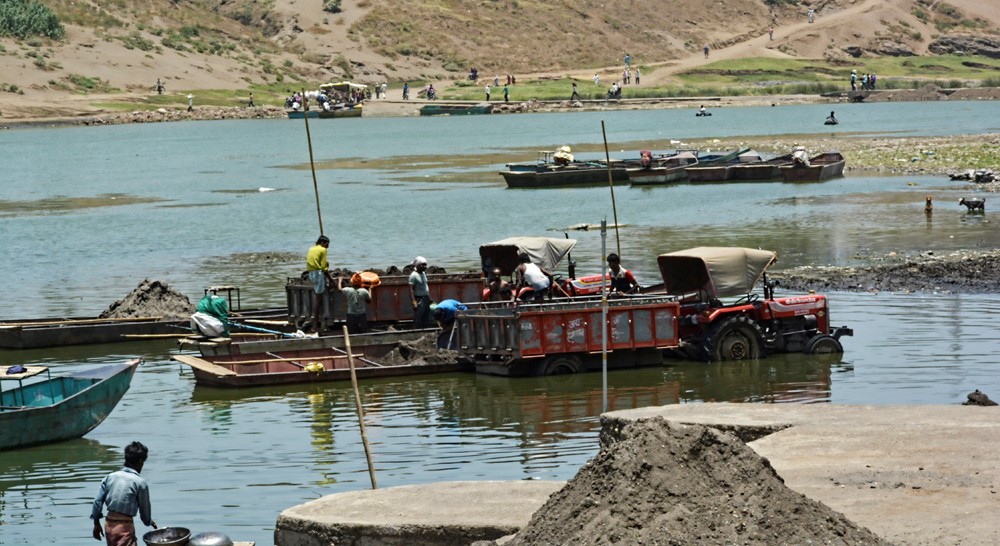
Of all natural resources, mineral aggregates (sand and gravel) have been the fastest growing and most extracted material group over the 21st century. This growth has not only been associated with large-scale ecological degradation, but also with violent extractive operations on local levels.

Given that sand and gravel are heavily used in the construction industry, particularly in concrete production, it comes as no surprise that the growth of infrastructure is the main driver for the overall rise in their consumption. What’s more, since 1970, increasing aggregate consumption has largely been observed in the global South—in regions which have witnessed massive economic and infrastructure growth. Continue reading “Sand and gravel: Rethinking aggregate consumption and distribution”

Questioning development: What lies ahead?

By Christiane Kliemann | EADI/ISS Blog Series

Development Studies requires “an epistemological and ontological change” write Elisabetta Basile and Isa Baud in the introduction to the recent EADI volume “Building Development Studies for a New Millennium”. The planned sequel of the book will take this analysis one step further and explore viable ways to build on both the critique of development as such, as well as the growing demand to decolonize knowledge production. The plenary session on “Questioning Development – Towards Solidarity, Decoloniality, Conviviality” at the recent #Solidarity2021 conference hosted a discussion by four contributors to the book which is currently in preparation for publication in 2023. The discussion is summarized here. Continue reading “Questioning development: What lies ahead?”