
Why the Next DSA and EADI Conferences Should Be Hosted in the Global South

By Luqman Ọpẹ́yẹmí Muraina and Aysha Valery

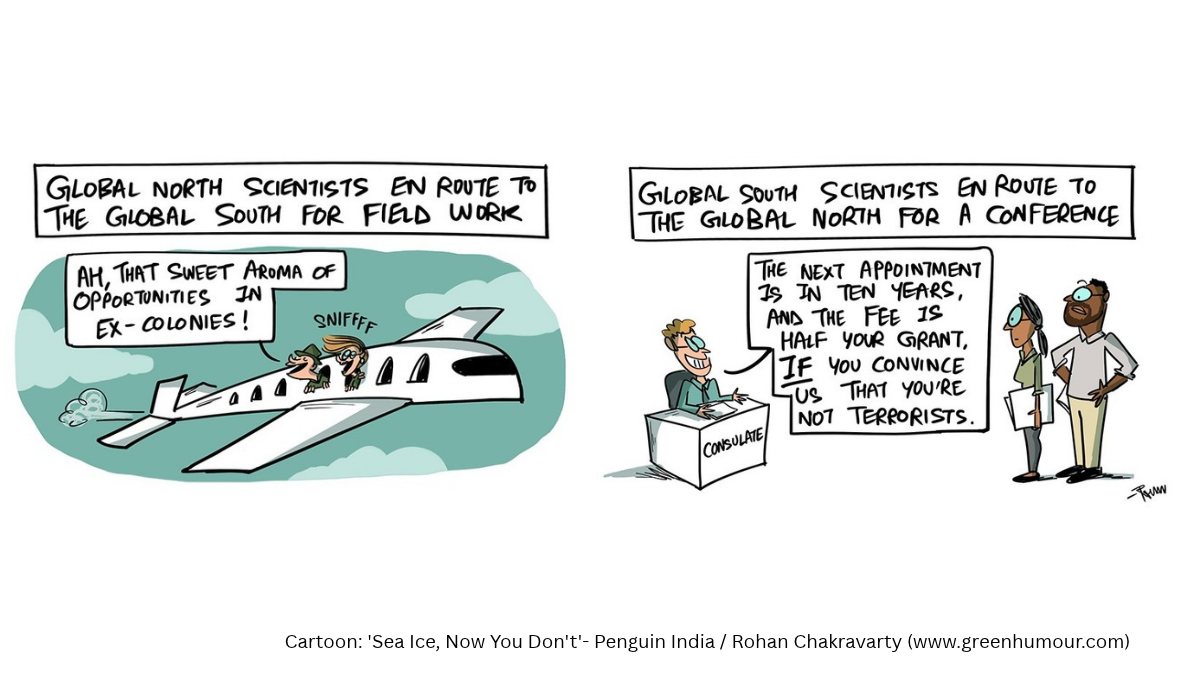
The Development Studies Association (DSA) conference held annually and the European Association of Development Research and Training Institutes (EADI) conference held every three-years bring together researchers, practitioners, and policymakers to discuss some of the world’s most pressing challenges – inequality, sustainability, environment, migration, etc.

Continue reading “Why the Next DSA and EADI Conferences Should Be Hosted in the Global South”


The Unintended Effects of Development Research Funding Structures Should be a Europe-wide Conversation

Do Big Research Grants Lead to the ‘Faux-Popularisation’ of Principle Investigators’s Flagship Concepts?

By Portia Roelofs / First post in a mini-series on large grant-funded research centres

In 1990 the Beninese political scientist Paulin Hountondji called attention to the role of concept generation and dissemination in ‘the North’s Monopoly on theory’. In recent years European Development Studies and adjacent discipline of African Studies has turned the spotlight on how this hierarchy is reproduced in conferences, journals, hiring and textbooks. With 70-85% of African research produced through international collaborations, and mainly funded by European countries, European research funding regimes are a key node in this landscape.

Continue reading “The Unintended Effects of Development Research Funding Structures Should be a Europe-wide Conversation”

Inverted Eurocentrism: The Consumption of Decolonization in the Global North

By Ingrid Harvold Kvangraven

At a moment when the United States has recently kidnapped the Venezuelan leader Nicolás Maduro, assassinated the Iranian supreme leader Ali Hosseini Khamenei, is plotting regime change in Cuba, and is continuing to support genocide and colonial oppression in Palestine, the question of how to understand empire, capitalism, and possibilities for resistance is as pressing as ever. In a new article, I argue that any radical decolonization agenda must be aligned with critique of and resistance to contemporary oppression. I also posit that the most dominant form of decolonial theory – the one that is now pervasive across global North universities as well as many institutions across the global South – does not lend itself to such radical critique and resistance.

Continue reading “Inverted Eurocentrism: The Consumption of Decolonization in the Global North”