
By Peter Taylor / Third post in a mini-series on large grant-funded research centres: read the previous ones here and here)
For many years, I have had the opportunity to work in large grant funded initiatives in different forms – projects, programmes and centres – as well as in many smaller collaborations. Often I have been a partner within an initiative, and at times I’ve had the privilege to lead large programmes. There is rarely time to pause and reflect amidst the hectic nature of these collaborations, but a recent initiative with Southern Voice has encouraged me to take the time needed to reflect on my experiences.
If we believe that equity in research is not simply a “nice to have”, but essential to quality in all its many aspects, then reflecting on our own practices in partnerships, as well as those of others, is really important. Learning from how equity has played out in projects we have been involved in ourselves is a key way to help strengthen how we work, engage and partner.
The “Equity in Research for Development” (ER4D) initiative, led by the Southern Voice network of think tanks with the Institute of Development Studies as a partner, has acknowledged a lack of equity in many research collaborations, particularly in those involving “North-South” research partnerships. Such research collaborations are very common within the global development arena and are often funded as projects through Overseas Development Assistance (ODA). Underlying power dynamics and structural challenges in such collaborations remain problematic and all too familiar. A new phase of the initiative led by Southern Voice is entitled “Action and Accountability for Equity in Research for Development” (ACT4Equity), indicating where its core interests and intent lie. Learning is central to this evolving work – learning with those who have introduced changes in their practices, and learning about what has happened as an outcome of shifts in policy or practice, and why.
Equitable partnerships – debates and dialogues
In recent years, efforts to advance equity in research partnerships have grown, particularly through initiatives focused on “equitable partnerships” and “localisation”. These efforts have often led to new guidelines, funding requirements and debates intended to increase localisation and address power imbalances in development research. However, critiques, particularly by writers and researchers in the global South, point to a persistent gap between ambition and reality. While many discussions of “equitable partnership” are valuable, they often remain aspirational and fail to generate concrete action on the deeper structural barriers to equity. Funders may express support for equitable partnerships but continue to use risk-averse practices that reinforce existing inequities and concentrate leadership of large projects, including research consortia, among a small group of institutions. There are also few meaningful accountability mechanisms through which Global South researchers can challenge Northern-based collaborators or funders over claims of “equitable partnership” made on their behalf.
Learning from experience – equity within two large grant research programmes
Against this backdrop of debate, I’ve been reflecting recently on two large grant research collectives I have been involved in myself in the role of Director – the “Think Tank Initiative” and the “Covid Collective”.
The Think Tank Initiative: a large programme of support to research institutions in the global South.
The Think Tank Initiative (TTI) was a large-scale (CAD$ 200million), ten-year, multi-donor-funded programme offering flexible, long-term funding combined with technical support for thinktanks in Africa, Asia, and Latin America. Implemented by Canada’s International Development Research Centre (IDRC), its aim was to help an initial group of 52 policy research organisations to move along a pathway to sustainability, generating a consistent flow of high-quality social and economic evidence, data, and analysis to ensure that research results inform and influence national and regional policy debates.
The TTI was quite intentional in its efforts to provide think tanks with the means to strengthen themselves, and to set their own policy-focused research agendas. Indeed, it’s “strapline” was “Local solutions for local problems”. As I discussed recently in a paper with Maria Alejandra Oviedo Ormeno, TTI originated because of the recognition that think tanks occupy a vital niche in the evidence ecosystem of many countries. When acting with a sufficient level of independence from vested (political or financial) interests, they can bridge the gap between research and action in a timely and effective way, engage with multiple stakeholders within a nation context, and find windows of opportunity in policy cycles to bring evidence to bear on pressing issues. They can also identify challenges that may arise in the future and shape an agenda for research that emerges from within their own context.
To do this effectively, however, think tanks need the resources – people, funding, infrastructure – that will enable them not only to think, but to do. Access to flexible funding over time, a hallmark of research equity, allows researchers to build, develop and take forward research agendas that are rooted in their own contexts and can respond to needs that they have identified collectively with relevant stakeholders. Sadly, many think tanks are surviving rather than thriving, on a subsistence diet of funding tied to narrow projects for which the priorities have been decided upon elsewhere. This situation is hardly equitable.
Whilst the journeys experienced by individual think tanks involved in TTI varied and often included challenges of different kinds – especially due to dynamic and often challenging national policy and political environments – the TTI responded to a demand for “core funding” that is still made frequently by researchers in the global South as a key way to achieve greater equity in research. Although only a partial means of support for think tanks that constantly have to navigate difficult territory, it did provide an important lifeline over a 10 year period, and many of those who received its support have thrived as a result.
The Covid Collective: embedding equity in an adaptive, complex research programme
During the Covid 19 pandemic, demand increased rapidly for a wide variety of research, including from social sciences, to help meet evidence needs amidst this global challenge. The Covid Collective research platform was launched in October 2020, coordinated by the Institute of Development Studies (IDS). It grew rapidly to a £5million project, starting with 8 partners, and finally having 35, undertaking 65 projects in 39 countries. As detailed in a learning report, the Collective’s two principle aims were to demonstrate the enhanced benefits of co-generation of research and evidence addressing the challenges of Covid-19, through a coordinated network of research organisations; and to support evidence-informed action through knowledge curation, learning, and strategic communication. A key objective was to facilitate collaboration, collective action, and mutual learning.
Given the fast-moving pace of the pandemic, and its impact in so many countries and contexts around the world, contextual knowledge was not only vital, but required rapidly. The Covid Collective needed to be highly collaborative, agile, adaptive and learning-oriented, whilst also ensuring that research equity was not neglected, particularly through attention to inclusion, transparency and accountability within partnerships. In short, without equity, research quality can be seriously compromised
It was important to all stakeholders that this should not be a “collective” in name only, but genuinely underpinned by equitable practices. Achieving all this was not easy. Moving quickly, particularly in a context such as a pandemic where the very terrain shifts almost on a daily basis, meant that decisions often needed to be made quickly. Although a central executive function was needed to facilitate decision-making processes, an advisory group involved representatives from many research partners, and regular webinars brought researchers together virtually. Because of limitations on travel and meetings, an in-person gathering of research partners could only take place at the end of the programme.
Even so, and aside from delivering on its core aims regarding generating and uptake of social science research during the pandemic, feedback from partners noted that equity had been a crucial dimension in their experience of the collaboration. They described the benefits and value of the Collective in increasing their conceptual understanding and learning from each other, and ensuring intersectionality in the composition of research teams and research focus. They also highlighted the value of expanding the reach of their research through the wider network, enabling their voices to be heard, and allowing their research to be shared, accessed and appreciated by a diverse range of audiences.
Conclusions
“Equitable partnerships” remains a conundrum. Movement from aspirations towards practical actions remains a challenge. Many researchers in the global South within large grant research consortia continue to be frustrated by negative experiences of behaviours, policies and practices within large research consortia. There are, however, useful lessons to be learned for Principal Investigators and Programme Leaders if developing a new project from research initiatives that are intentional about strengthening equity, particularly when those initiatives are led by global North institutions. This may involve them being underpinned by structural mechanisms that explicitly address power imbalances associated with control over funding; or because they involve intentional processes and ways of working that are themselves equitable. In new large grant research consortia, approaches that Principal Investigators or Programme Leads can take might include:
- providing flexible resources and support that centre research agendas and priorities of those whose voices and knowledge are marginalised and unheard
- helping to expand networks or the reach of network members to learn from and collaborate with a widening array of actors;
- enhancing conceptual understanding, skills and capabilities of all partners through ongoing processes of joint reflection, learning and knowledge exchange
- supporting intersectionality through inclusion of contextual knowledge and experience
- opening new funding opportunities that enable researchers and research institutions to achieve greater resilience in the longer term.
These approaches, whilst not always easy to implement, do offer the potential to respond in practical ways to the desires of many researchers in the global South to embed more equity in research for development. Ultimately the emergence of a sustainable, equitable knowledge ecosystem, and the success of large, complex research consortia, depend on all members to survive, and to thrive.
Peter Taylor is Professorial Fellow, Institute of Development Studies
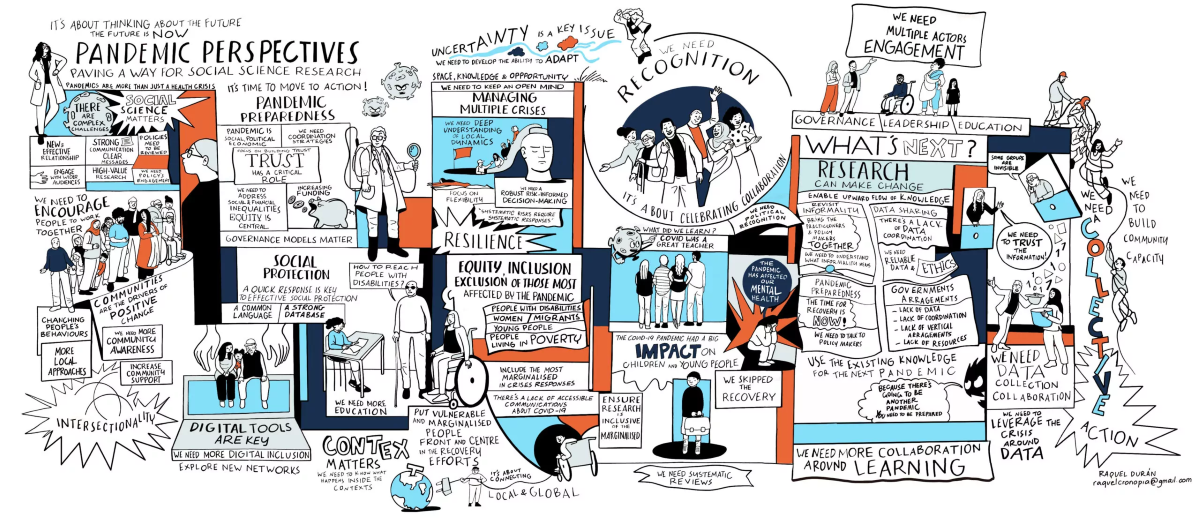
Image: Covid-Collective
Note: This article gives the views of the author, not the position of the EADI Debating Development Blog or the European Association of Development Research and Training Institutes