

Do Big Research Grants Lead to the ‘Faux-Popularisation’ of Principle Investigators’s Flagship Concepts?
By Portia Roelofs / First post in a mini-series on large grant-funded research centres
In 1990 the Beninese political scientist Paulin Hountondji called attention to the role of concept generation and dissemination in ‘the North’s Monopoly on theory’. In recent years European Development Studies and adjacent discipline of African Studies has turned the spotlight on how this hierarchy is reproduced in conferences, journals, hiring and textbooks. With 70-85% of African research produced through international collaborations, and mainly funded by European countries, European research funding regimes are a key node in this landscape.
A big grant win is one of the great achievements of an academic career. Being a ‘principle investigator’ – commonly referred to as PI – on a big grant gives one a position of intellectual leadership, with one’s own work forming the basis of flagship concepts and guidance for a team of researchers who are also ‘on the grant’. In the years following such award it’s not unusual for PI’s to see an increased uptake of their main ideas. Indeed, given the structure of academic metrics like citation counts and the H-index, this popularisation of new concepts is both a marker and driver of success.
But is this swell of usage always a genuine indicator of the usefulness and applicability of a new concept? Or might there be mechanisms through which a big funding grant leads to the ‘faux’ popularisation of concepts coined by their PIs?
My 2025 article in the Journal of Development Studies looks at this question in the context of two large-grant funded research centres (LGRCs) at a major London university in the mid-2010s. I argue that we can apply a rule of thumb test to see if the uptake of a concept is a sign of genuine applicability across cases.
i) Does the author directly quote the original definition of the term?
ii) Do they cite where they got that definition from?
iii) And, in that citation, do they use a specific page number?
These criteria make use of citations as a “trail of breadcrumbs”, so to speak, enabling a reader to trace back the concept to its original usage. Readers then have the tools to decide for themselves whether the case discussed by the original author, and any subsequent cases, are really instances of the same phenomena. This continuity of conceptual definition is required if we are to say that the PI really did identify a common trend across cases.
In the case I looked at I found that research outputs from large grants do indeed make extensive use of the flagship concepts devised by their PIs. I looked at a series of six research reports published by the Conflict Research Programme in 2016-2017. I found 205 uses of the concept of ‘the political market place’, which was coined by the Centre’s PI. This represented an uptake of the concept by a pool of 20 researchers – many from the Global South – working across 8 country case studies: a clear case of popularisation. However, when applying the criteria above it is not possible to tell whether this extensive usage is actually evidence of widespread applicability or faux popularisation. Whilst the research reports name-check the political marketplace over 200 times, it is only once linked to a quoted definition and on no occasions at all is this linked to a citation with a page number.
Of course, this is only one concept, in one LGRC, and a wider assessment of the total outputs of the centre show much more variation in conceptual frameworks. However, it points to the potential for large research grants to have unintended effects, leading to the production of a large body of work which may give a misleading impression of the scale of the evidence base for flagship concepts.
To some extent the cases I looked at are specific to a specific time and place. A conjuncture of factors arose from conditions facing British development funding and higher education funding in the 2010s. In terms of development research, overseas development aid had been ringfenced at a time when government spending more generally was subject to austerity. This meant that within the Department for International Development fewer staff were trying to get more money out the door. What I call the ‘large grant-funded research centres’ model became a way to outsource quality assurance in development research spending. High-profile academics with a track record of publications and impact were given control of at first £5m and later up to £30m research budgets, on the basis of competitive bidding. In line with ministerial visions of British development research as a ‘global public good’, the grant calls for these competitive bids required applicants to make big claims as to the wide-ranging applicability and thus analytic power of their ideas.
On the university funding side, the Browne Review in 2008 meant that by 2015 – when schemes like the Global Challenges Research Fund came on stream – universities were fighting for student fees capped at £9k, the value of which was being eroded year on year. In this context universities were dependent on ‘grant superstars’ who could bring in large sums of research funding, a portion of which was allocated to institutional overheads.
As I show in the article, these factors combined to drive the centralisation of research funding and to create LGRCs which were ‘pyramid shaped’ with one or two PIs managing a large pool of more junior researchers.
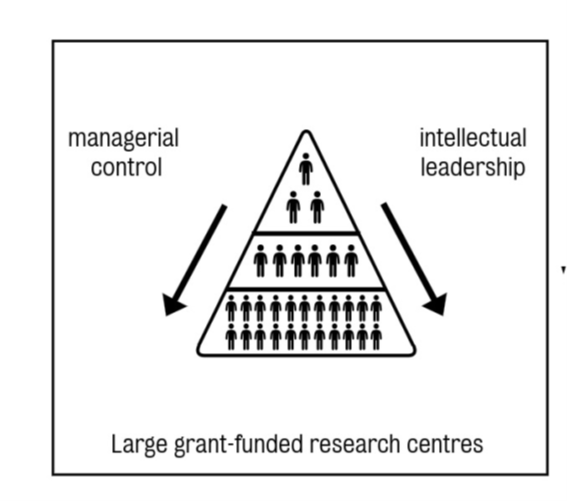
Shifting to think about development research at the European level, many of these specific conditions may not apply. French laboratoires de recherche have their own institutional histories, as does the Deutsche Forschungsgemeinschaft. Regardless of the specific national funding regimes, however, we should be alert to a number of ‘shared pathologies’ that make the faux popularisation of PI’s flagship concepts more likely:
- The overlap of managerial control with intellectual leadership
- Ex-ante lock-in of concepts at the grant application stage where applicants are encouraged to make promises about the applicability of key concepts prior to the development of a genuine evidence base
- The obligation on funded academics to commit to producing social media content and policy-relevant grey literature even where their actual research findings may be ambiguous, uncertain or contested.
Modalities of European research funding – whatever its national variations – risk leading to the faux popularisation of concepts developed by already high-profile senior academics. Insofar as the structure of grant bids reinforces the influence of concepts coined by senior, white European men, we can diagnose this as another strand in what Hountondji described, almost 40 years ago, as “the North’s Monopoly on Theory”. Such a clear-eyed diagnosis is a necessary first step in devising alternative funding models which can deliver the high-quality development research the world currently needs.
Dr Portia Roelofs is Lecturer in Politics in the Department of Political Economy, King’s College London. She has degrees from the University of Oxford and SOAS and did her PhD at the London School of Economics. Her work explores questions of accountability in Nigerian politics, political theory and the politics of knowledge production. Her book Good Governance in Nigeria was published by Cambridge University Press in 2023 and Noirledge Publishing, Nigeria in 2024.
Image: Pixabay
Note: This article gives the views of the author, not the position of the EADI Debating Development Blog or the European Association of Development Research and Training Institutes