
By Zuhour Gharaibeh
Funding ends, but needs do not. A project may close successfully: activities were delivered, the budget was spent, and the target number of participants was reached. But did anything actually change in people’s lives? Are they now more able to make choices and influence decisions, or did success remain confined to the project indicators during its implementation?
Funding is essential, especially where needs are growing and local resources are limited. The problem is not the grant itself, but the order in which the process begins. Does development start with the community and then seek funding, or does funding come first, followed by a need shaped to fit it?
When funding defines the need
An organisation may feel compelled to pursue available opportunities even when they do not fully match the priorities of the community it serves. In some cases, a programme begins not with the question, ‘What do people want?’, but with the grants currently available. Training sessions and activities are repeated, organisational priorities shift with donor agendas, and some basic needs remain unanswered. This echoes Arturo Escobar’s warning that the development discourse does not merely describe problems; it can also shape what is recognised as a problem and which solutions appear possible.
An organisation’s theory of change should therefore be rooted in the social change it hopes to achieve, not in changes in funding programmes. In practical terms, it should know what it wants to change in people’s lives, how that change might happen, and what will remain when the project ends. Funding should support this pathway, not define the need on behalf of the community.
Attendance is not participation
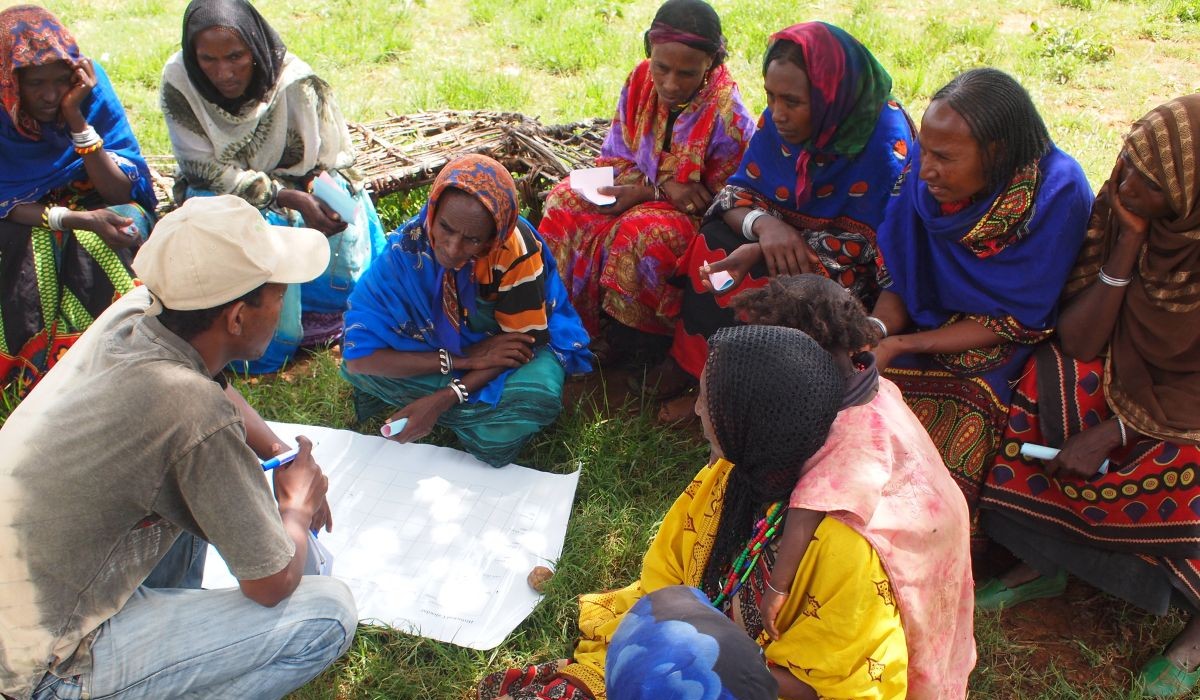
People are not merely ‘target groups’; they hold knowledge about their own lives. Who decided that women need this particular training? Have young people been asked about their interests and the opportunities available where they live? Who defines quality of life for older people? And did planning begin in cooperation with persons with disabilities, or was it done for them? Their priority may be a job opportunity, transportation, childcare, an accessible service, or healthcare – not another training course.
There is a fundamental difference between inviting a community to a meeting after a project has been designed and involving people in defining the problem before the proposal is written. Development practice has evolved: community-driven approaches increasingly seek to give local people a role in choosing priorities and managing projects. Yet the question remains how much influence they actually have. A recent World Bank review of community-driven development finds that well-facilitated processes can reflect community preferences, while also recognising the risk that local elites may dominate decisions. A survey, a consultation, or a large audience therefore tells us who was present; to assess participation, we must also ask whose priorities shaped the proposal.
Attendance may mean sitting in a room, listening to a trainer, signing a register, and receiving a certificate. Participation means having a voice that makes a difference: being able to question the need, reshape the activity, object to what does not fit, and suggest alternatives grounded in lived experience. Attendance does not necessarily mean participation, just as being heard does not mean that people’s views actually shaped the project.
In some programmes, attendance is linked to transport or volunteer allowances. These may be necessary for people with limited incomes or those travelling from distant areas. Yet when the first question is about the allowance rather than the activity, we should ask whether the programme has built community ownership or only a temporary relationship that ends with the event.
When development becomes a project
When a long-term social issue is compressed into a one-year project, and change is reduced to the number of activities and participants, development becomes governed by the project’s lifespan. This is sometimes described as the projectification of development: organising development work through time-bound, technical projects even though social change requires time, accumulated knowledge, and a continuing relationship with the community.
Projects are necessary tools for organising resources and responsibilities. The difficulty arises when the requirements of a project proposal begin to determine which needs can be recognised and addressed. This concern is still present in recent research, but development practice has also changed: donors and organizations increasingly seek to give local actors a greater say. A 2023 study of foreign aid contracts found that donors do give beneficiaries a say in some project decisions, but usually within parameters set in advance. This is real progress, while leaving open the question of who gets to define the problem before the project takes shape.
A staff member asked to prepare a proposal within days, implement activities within months, and then close the project and submit a report may spend more time managing deadlines and documentation than understanding how change unfolds in a community. This does not necessarily reflect a lack of competence. It reflects the pressures built into the way some projects are funded and managed. A 2024 study of development projects in Uganda and Vietnam shows how donor requirements are interpreted and adapted through everyday work and relationships between organisations. What a project promises on paper, therefore, cannot tell us on its own how the work happens in practice.
Anthropology offers a practical response: participant observation, listening to people’s stories, and spending time within communities. These approaches may reveal that what appears to be a lack of training is actually connected to transport, care responsibilities, limited employment opportunities, or social restrictions that training alone cannot solve.
What remains after the project ends?
The real test begins after a project closes. Did knowledge remain within the organisation? Was experience transferred to local staff? Is the community better able to make decisions? Did a service, partnership, or working method continue? Or did everything end with the team and the budget?
These questions do not diminish the value of activities or participant numbers. They shift attention from ‘What did we deliver?’ to ‘What changed, and what continued?’ This is consistent with the OECD evaluation criteria, which consider impact and sustainability alongside effectiveness. A project’s success is measured not only by what it achieved while it existed, but also by what the community and the organisation were able to continue after it ended.
Reordering the starting point
The alternative is not to reject funding, but to reorder the process: the community defines the need, the organisation designs a long-term programme, and funding supports parts of it. This begins with regular needs assessments that do not wait for a funding call, and with simple community knowledge bases or observatories that preserve what organisations learn from people and previous projects.
The programme can then be divided into stages supported by different funders, with enough flexibility to adjust activities when realities change. Indicators should capture what happened in people’s lives, not only how many sessions were held. Did access to opportunities and services improve? Did people gain greater influence over decisions? Did the benefit continue after the grant ended?
Institutionalisation should also begin on the first day, through transferring knowledge, documenting methods, building partnerships, and identifying what can continue with local resources. This does not remove the need for external funding. It makes funding part of a longer development pathway rather than the beginning and end of the plan.
Participatory action research offers one practical way to reorder this process. When time and resources are limited, rapid participatory assessment—through focused conversations, community mapping, observation and small-group discussions—can help institutions identify priorities with people before funding proposals are drafted. But it should not become another one-off consultation. Its purpose is to create a continuing cycle of listening, collective analysis, action and reflection, giving communities real influence over the problems addressed and the direction of resources.
This critique is not an accusation directed at donors, organisations, or development workers, who often operate under genuine constraints. It is an invitation to reconsider a model that may spend its budget and reach its numerical target without leaving change that survives beyond its paperwork.
The question, then, is not whether communities need funding – they do. The question is: who defines the problem, who determines where the funding goes, and what remains in people’s lives after it has been spent? Development that does not listen to people may succeed on paper, but it can end before it begins in their lives.
Dr Zuhour Gharaibeh is a Jordanian social anthropologist and development practitioner. Her work focuses on community development, women’s and youth participation, and the relationship between institutions and local knowledge.
Image: Climate Change, Agriculture and Food Security (CGIAR Climate) on Flickr
Note: This article gives the views of the author, not the position of the EADI Debating Development Blog or the European Association of Development Research and Training Institutes
مقال رائع وعميق دكتورة زهور
لقد وضعت يدك على الجرح تماما في تشخيص واقع العمل التنموي. فكرة أن التمويل يجب أن يدعم مسار التنمية ولا يحدد الاحتياجات بالنيابة عن المجتمع هي رسالة غاية في الأهمية
كل الشكر على هذا الطرح المتميز